

PORTFOLIO / FIELD NOTES
Every project is priority one.
We have forty-seven of them.
What is project portfolio management? Officially, it’s the selection, prioritisation and control of an organisation’s projects and programs in line with its strategic objectives and capacity to deliver (APM). Lovely definition. So what?

Dawid Jasinski, PhD · 8 min read
IN THIS ARTICLE
Every company runs two project reviews. The official one has forty slides, a dashboard where everything is green, and a sponsor who has been checking email since slide five. The unofficial one happens in the kitchen, takes four minutes and is the only one where anybody tells the truth.
Meet the regulars of the bay.
01
The fry
Do the work. Know the real status. Never invited.
02
Catfish & perch
Turn red into amber, amber into green.
03
The whales
Approve everything. Prioritise nothing. Arrive at noon.
7:30 — The fry
The catfish are still asleep when the fry swim into the kitchen in search of life-giving coffee. Half-awake, they compare notes on yesterday’s portfolio of miracles.
“Why did we postpone project X? Again?”
“Because project Y became priority one.”
“I thought project Z was priority one.”
“It is. We have forty-seven of them.”
Someone mentions that the new workstation for project Y won’t even fit on the assembly line. Nobody answers. The drawing was approved anyway: the line is a detail, the slide was beautiful. Another sip of coffee.
The caffeine kicks in, and the fry dart back into the bushes to update a status report nobody will read.
9:00 — Catfish & perch
Bigger, older and considerably more experienced fish take over the kitchen. The grinder spins, the coffee brews, and the complaints start to sound like strategy.
“What criteria do we actually use to select projects?”
“Officially? Strategic fit, business case and risk. Unofficially? Whoever presented to the board last.”
“I can’t staff anything new without delaying everything we already have.”
“Then plan everyone at 120 per cent. It worked last year.”
The catfish know the truth as well as the fry do. They simply have a talent the fry have yet to develop: turning a red project amber before lunch, and an amber one green before the board meets. Green on the outside, red on the inside. Consultants call it watermelon reporting. The catfish call it career planning.
12:00 — The whales
Around noon, the whales roll in. Thunderous laughter, booming voices, an excellent mood. The quarterly review has just ended. A few challenges here and there, none of them made it to lunch.
How? Those who are always right have a proven rule: every problem has a first and last name. Find the culprit. The project manager gets “a new challenge” in another department, and the project gets a new name. “Digital Transformation” becomes “Digital Transformation 2.0”. The budget moves to phase two, the deadline to the next fiscal year, and the lessons learned to a SharePoint folder nobody will ever open.
“Great progress, team. Let’s keep the momentum.”
A quick translation for anyone new to the bay:
THE SLIDE SAYS
Re-baselined
Means: late.
THE SLIDE SAYS
Strategic priority
Means: the CEO saw it at a conference.
THE SLIDE SAYS
Quick win
Means: nobody has estimated it yet.
The laughter spreads through the bay. The fry laugh because nothing they do makes sense. The catfish and perch laugh at their own hopelessness: they agree with the fry, but they are paid to make the unreal real. And the whales laugh loudest of all, already celebrating a success that will never come.
Sound familiar? If your project goals have “mysteriously” been missed again, you don’t need another recovery plan. You need project portfolio management.
Why bother? Five reasons
01
Balanced. Not burned out.
“To maintain a balanced and strategically aligned portfolio in the context of changing conditions.”
— APM Body of Knowledge [1]
Balanced does not mean working 300 hours in the month after your holiday to even things out. And strategically aligned does not mean aligned with the team leader’s personal strategy of becoming boss of all bosses.
A balanced portfolio mixes quick wins with long bets, safe projects with risky ones, keeping the lights on with changing the business. Aligned means every project can name the goal it serves — out loud, without checking the slides.
Markets, budgets and people keep moving. So the balance needs checking more often than once a year at the planning ritual.
Ask: If we cancelled this project tomorrow, which strategic goal would feel it? If nobody can answer in ten seconds, you have your answer.
02
Twenty plans. Three people.
“To improve the delivery of projects and programme through a wide view of risk, dependencies and scheduling reflecting available capacity.”
— APM Body of Knowledge [1]
Every project plan looks great on its own. Put it next to twenty others, and the same three specialists turn out to be booked for March three times over.
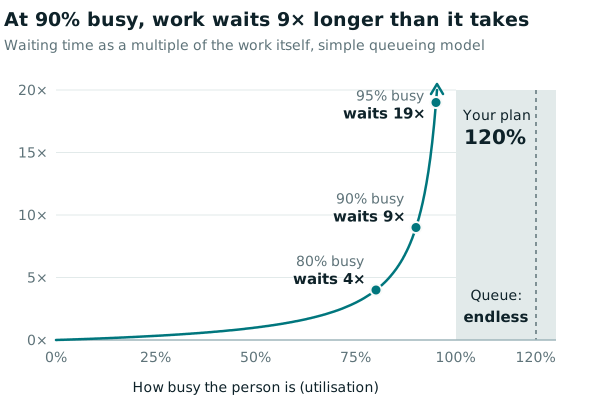
Overload doesn’t grow in a straight line. At 90% utilisation, every task waits nine times longer than it takes, and at 120% the queue never ends. That’s not a metaphor. It’s queueing theory [3], [4].
The portfolio view shows what no single project can: shared risks, dependencies between deliverables and the real capacity behind each schedule. It moves the focus from doing projects right to doing the right projects — in an order that actually works.
The question stops being “Is my project on track?” and becomes “Can we deliver all of this at the same time?” Usually, the honest answer is no.
Ask: What is our scarcest expert planned at? Above 80%, the deadlines are wishful thinking.
03
Kill your darlings.
“To reduce costs by removing overlapping, poorly performing, and non-strategically aligned projects and programmes.”
— APM Body of Knowledge [1]
This means ruthlessly cutting every project that doesn’t support the strategy or doesn’t promise success — no matter how much money is already buried in it.
That money is gone either way. The only question that matters is whether the next euro is worth spending. The more we’ve invested, the harder it is to pull the plug, even when the business case died quietly months ago.
Overlap is the stealth cost: two departments building the same tool, three teams piloting the same idea. Nobody notices, because nobody looks at all the projects at once. A stopped project isn’t a portfolio failure. Often it’s the best decision of the year.
Ask: Do we still need this project, or do we just feel bad about the money already spent?
04
Approval doesn’t clone people.
“For more efficient and effective use of limited resources, by matching demand and supply, and optimising the allocation of available resources.”
— APM Body of Knowledge [1]
Signing off a project does not create the people to deliver it. Yet organisations approve projects as if capacity were infinite — and then act surprised when everything is late.
Demand always beats supply. The only question is where the trade-offs happen: openly, at portfolio level, or quietly, at somebody’s desk at nine in the evening.
Matching demand and supply means knowing who works on what, which skills are the bottleneck and what has to wait. Sometimes the smartest use of your scarcest expert is to finish one project before starting the next.
Ask: What will we delay or stop to make room for this?
05
A Bugatti without an engine.
“To increase realisation of forecast benefits and the identification and realisation of unexpected benefits to create additional value.”
— APM Body of Knowledge [1]
Because the whole point of a project is business value. A brilliant project that delivers no value is a Bugatti Chiron without an engine: gorgeous, expensive and going nowhere.
Benefits rarely show up on closing day. They arrive months later — in operations, in sales, in someone else’s budget. Portfolio management follows them after the project team has moved on, and it spots the unexpected ones too: the accidental side effect that beats the original goal.
Ask: Who will check whether the promised benefits actually turned up?
So what is this project portfolio management?
After the fish, the coffee and the Bugatti, here’s the official answer from the Association for Project Management [2].
THE DEFINITION
Selection, prioritisation, control.
In line with strategy and capacity.
“Project portfolio management is the selection, prioritisation and control of an organisation’s projects and programs in line with its strategic objectives and capacity to deliver.”
Strip away the jargon and three verbs remain:
01
Select
Pick the projects worth the money.
02
Prioritise
Decide what goes first and what waits.
03
Control
Keep checking. Kill what no longer fits.
Every problem has a name. Renaming the project won’t fix it.
Sources & further reading
[1] APM Body of Knowledge, online edition, apm.org.uk/body-of-knowledge, accessed 26.07.2018. Source of the five quoted reasons. That page is no longer online; the current edition is the APM Body of Knowledge, 8th edition.
[2] APM — What is portfolio management? Definition based on the APM Body of Knowledge.
[3] J. F. C. Kingman, The single server queue in heavy traffic, Mathematical Proceedings of the Cambridge Philosophical Society 57(4), 1961, pp. 902–904. The utilisation chart shows the simplest case of queueing theory, the M/M/1 queue: waiting time = ρ/(1−ρ) × the work itself, where ρ is utilisation. Kingman’s formula generalises it to any heavily loaded queue.
[4] D. G. Reinertsen, The Principles of Product Development Flow, Celeritas Publishing, 2009. Applies queueing theory to product development and projects: queues grow sharply as utilisation approaches 100%.
One idea a month on portfolio decisions
No schedule padding, no roundups. A single method, failure pattern or decision framework, explained properly.